Monday, July 14, 2014

July Garden Updates

I actually have June pictures also, but I am pretty sure I missed the boat on writing about June, so here it is July. This year I am keeping track of how much edibles are being produced. Each time I come in with a harvest I set it on the scale and weigh what I brought in. By the end of June I had harvested over 20 pounds of delicious strawberries from those six plants I put in the Fall of 2012, so this is only their second growing year in my yard. Here is a photo of the size of the patch now:


All told, the patch is approximately 8 feet long and five feet wide and the patch produced 20 pounds of these beauties:


While they are not as sweet as their tiny, wild cousins, these are so much sweeter than the supermarket ones, with no tasteless "core" because they ripen on the plant fully before picking.

My potato in a hamper experiment seems to be going well. I did try to fish out some potatoes, but only managed to find one small one, so I am leaving it be until I can properly harvest them, which should be fairly soon.

Just when I was about to give it up for lost, the potatoes popped through at the end of May. I could not contain my joy. :)
By the end of June I had already hilled them twice and they were starting to peek over the top
This is what my plants look like today (14 July 2014)
 I should have hilled them one last time before they bloomed, but that will be a lesson to put to work next season as these have blossomed and the blossoms have fallen off already. At the bottom you can see some of the foliage growing out the sides. Hmmm.. that gives me some ideas.

I got this hamper on sale at Family Dollar for six bucks I think. I am optimistic that we will have at least a couple meals of potatoes from my garden this year, and if so, I will be planting more next Spring.

As for the rest.. everything is growing as fast as the weeds. My trial planting Mexican Sour Gherkins, aka mouse melon cucamelonMexican miniature watermelon and Mexican sour cucumber has been going well. They do take over a spot! So far the fruits are minuscule, but I did try one and it was packed with a lovely flavor, far more than the small size would suggest. My lettuce bolted before forming heads, as usual, but I tried cooking it and the stems and found that it is quite tasty. More on that as I experiment. Here is the view of the rest of my garden, including the raspberries that are producing this year! I have already planned for the expansion as they are spreading rapidly, with or without my permission.


This was my 3 Sisters in July. There are popcorn plants, beans (Kentucky Blue) and round zucchini. The beans keep getting eaten before they can grow. In the foreground are asparagus ferns (I was told that was okay for the first year planting)

And this is the 3 sisters today. There are baby zucchini growing an everything is noticably taller and more full. Something is nibbling on the greenery though, I am pretty sure they are slugs and garden snails as we have a lot of those around and they like to leave holes in leaves. As long as it doesn't hurt the yield too much I can be patient. Once my patience wears out I will be serving an open bar (flat beer in a dish). At least they go happy.

Up against the fence are my raspberries that my lovely neighbor gave me last year. The poles an sticks are keeping the net off of them. The net is helpful in keeping the birds away from the fruits.

Here is my back yard. Please ignore the ugly parking lot on the right, there is supposed to be a fence blocking the view. Way down the end is the 3 sisters mound and to the right of that my winter wheat which was destroyed after a particularly windy storm. The strawberries are off screen to the left and the raspberries a bit behind me. 

I am so proud of these, as well as the sunflower next to it. I have three beautiful cabbages that are close to being ready to harvest.

Although it is a little hard to see, between the two green poles is a netting that I created with twine and up that are the Mexican Sour Gherkins. I think I prefer "Mouse Melon" though.  
It is next to impossible to get my family to eat salad, so here is a lot of bolted lettuce. Preliminary attempts at braising have yielded promising results. Stay tuned.

Some how, some way, my lemon balm survived the winter unprotected in this container.

On the left is my last year's Sage, and in front is some lemon grass. In the round container in the back are the chives and marjoram that survived the winter too. The container on the right is last year's chamomile struggling to live. 

Here are just a couple tomato plants after a deep pruning along with pepper plants and nasturtiums.
My garlic was puny, but the tops wilted back so they are pulled. These small garlic are quite sweet though, so that is a bonus to me. I have put out some more seeds for a Fall harvest of chard, but I think the birds ate them up.

My son gathered his friends to help out last week. They brought some food and worked their tails off pulling weeds, planting the old, dying blueberries and clearing out the branches from various storms. They spent so much time weeding my wheat, I feel awful that the very next day a storm beat the grains out of the entire planting. At least there is still the straw mulch.

Wormy Composting

At the beginning of this summer I was bequeathed with red wigglers, aka vermiculture worms for composting inside the house.  Armed with the almighty internet and a passion for research, as well as a little pain reduced time, and I built a box for keeping them. The premise is fairly simple, one box to live in, one to make a new home when necessary and one to catch any drips. I did try to cheap out a little and just use two levels, but that makes transferring the worms difficult. It can still be done, using one of the lids to the totes as a drip catcher, but I found that set up to be less stable using the materials I had available at the time. I chose the most simple way possible, but when I think on it, I am sure that there are other configurations that could be more efficient in terms of materials.

This is what you need:

2 plastic totes.

Mine are of the medium sized variety. They should not be too deep, you want enough space for the scraps and then some bedding on top of that and I like having some extra head space in case these normally homebody worms get freaked out and try moving up, as they did when I first put them in their new home.
It is important that the totes do not nestle inside each other tightly. Since the ones I had available did nest tightly, I put a couple of rocks between the two, just under the handles, to give it a bit more space.

2 drill bits (and a drill!)

I do not have the exact sizes, and that isn't terribly important. The large holes were under 3/8th inch, but larger than 1/8th inch, and the small one was under 1/8th of an inch. The large holes are to allow the worms to migrate when harvesting the lovely composty material. They start out really small and skinny, but I had no idea how fat they could get, so I err'd on the side of a bit big. The small bit is just to pop in some air holes. I doubt they are small enough to keep the worms from crawling out if they really wanted too, but they are non migratory by nature, so my hope is that the narrow holes will dissuade any adventuring type worms.

Strips of damp newspaper. Just soak the strips and wring very dry.

Food scraps, a couple days old and chopped up ideally, but it is not necessary. Just do not feed them any animal products except some crushed eggshells (with the membrane removed, which is a pain, so my eggs shells go straight into the garden usually) and do not put citrus fruit scraps in there as too much acid messes with them.

Now for the fun.

Take one lid and drill some small holes in the top like so:


Around the top portion of two of the totes, drill some small holes too. These are for ventilation. I have a fear of opening the darned thing and having something terrible come out, like very strong odors or worse, decomposing worms.


These will be your worm nests. The worms live in one, and after a few months it will be filled with a compacted mix of bedding and worm poop! When that happens, they need another, clean nest, to live in. This is where the bottom holes come in. As well as allowing any liquid to drain, these holes make is easier for the worms to move downward when the time comes. I tried to just use the one nest, but when I went to sort through to remove the worms I realized that I was going to lose a lot of them because they look just like their surroundings at that point. So, I made two of the above totes and drilled these holes in the bottom:


So, now you have two totes with small air holes near the top and a few larger holes on the bottom as well as a lid with some small holes drilled in. The third tote needs no holes, but if your bins fit tightly you may want to put something there to keep a space between the totes so that the water can come out if there should be any. I have not seen any liquid dripping from mine yet, but they say it does happen. I am still on a learning curve, but I have had them for over six months and they are still alive and kicking, so to speak.

I just used some empty toilet paper rolls to lift the bins up a bit. They don't last long, but there is a continuous supply until I find four items of equal height to replace them. I don't use canned goods often, so I rarely have more than a couple around. That, and I do not want to deal with the rust. I am that lazy.


Now, put them all together, the one tote with no holes on the bottom to catch anything that may come out. So far I have only had a very little bit of what looks like worm poop (castings, which technically all the compost will be)


You are scratching your head and thinking "Why are there only two bins? Why did I put holes in a third?" The reason is, this was my first attempt and I have not had a chance to photograph the other and am too lazy at this moment to go take one. Hey, it is hot out there. Not good for the chronic pain, believe you me. The third tote just goes on top.  If you wish, you can just make the two totes with holes and use the lid that you did not put holes in as a catcher underneath. I am not so brave as I did not know how much liquid would come out and I was not convinced that the worms would not escape.

In the very top container, put your scraps. On top of the scraps, loosely layer the damp newspaper shreds (I used the ads and flyers as I do not get a physical newspaper anymore, and neither do my neighbors so I could not scavenge them from recycling bins). Put your worms on top of that, and here is a major trick, keep the top cover off and put the whole thing under a light. The worms instinctively move down, away from the light. I did not do it that way at first and even two weeks later, most of the worms were still near the top. You would think the need to eat would encourage them downward, but I am thinking that without noses they don't know it is there.
Mix a little dirt or used up coffee grounds in with the scraps as the worms need a bit of grit to digest properly.

After a few hours, check to see if the worms are no longer on top of the bedding and put on the cover with the holes in it. The rule of thumb is a one to one ratio of scraps to worms. One pound of worms (about a thousand red wrigglers) can eat a pound of food in a week. Mine are quite a bit lazier than that, so start with less and work your way up. If the nest material looks dry when you check, spray some water. They don't need a lot, as there is a lot in the food, but the damp is supposed to be good, as long as it isn't sopping.

In three months or so, you are going to have to change the bins. To do this, lightly loosen the castings in the occupied bin. In the unoccupied one, create a new home, just as you did at the beginning. then, set the old home on top of the new, making sure that there is space between the bottom of the totes. If they are not moving, which honestly, I am not sure how they survived long enough to get this far as mine are super lazy, just set them under a lamp again, coming in occasionally to remove castings and stir up any remaining to get the worms to move down to their new home.

That is it. I have thought many times that my neglect had killed them. When you have chronic pain, sometimes that takes priority, and my flare last a week or more sometimes, leaving me with a lot of backlogged work that must be prioritized to get done before the next flare which is not predictable. Despite this, my worms are thriving. I even found them mating in a big old squirmy worm ball.
These worms do not have a male/female system, but they do need each other to reproduce.

Ah, the pectin

So, I promised an update on the great homemade pectin experiment. So far it does work, but I have not been able to get it to gel as firmly as jams do with the store bought kind. I ran out of strawberries before I could continue experimenting with different batches, but it did gel a bit, more like a very thick and chunky sauce rather than a more spreadable jam. It is still delicious and some was eaten on waffles and I bet the jam would be excellent on a piece of sponge cake in the middle of winter while dreaming of the Spring's gardening ahead.

Making your own pectin is actually pretty simple, especially if you save all of your apple scraps in the fall from making all of those yummy goodies that the fall harvest brings.

The fruit that I know has the most available pectin (off hand, there may be others) are apples. Grannysmith have more, as do those that are slightly unripe. Crab apples are brimming with the stuff, so if you find a safe source somewhere, that is free pectin on a tree. The pectin lives mostly in the cores and peels, but in this case I used whole Grannysmiths due to that is what I had in the house and I did not have a lot of them in the crisper drawer.

The first step is to scrub those apples. Commercial apples are sometimes waxed and often sprayed with insecticides. Even organic types will have residue from handling and sometimes an organic waxing product to help keep them looking fresh for shipping and storing.


Yes, that is a regular scrubber. Make sure it has been sanitized though as sponges are notorious as little bacteria factories. No one wants to eat that. I use lukewarm water to help loosen any waxes that may be holding on to the skin.

Next, chop them all up, cores, peels and all. If you are using scraps you may want to chop up the cores a bit if they are whole. The more surface area that is exposed the less heating will be needed to extract the pectins.


After cleaning and chopping, throw them into a slow cooker or deep, non reactive pot for the stove top, or, if you are okay with heating up the house, this can be done in a covered baking dish on a very low oven. I have not used the oven method, so I have no tips on making it work properly. Personally, I love my slow cooker as has been mentioned in the past a "few" times.

The next step is to put in 1/2 a cup of water. This is just to prevent any scorching before the apples exude their own juices. If you are not using whole apple you may need to add a bit more.


Put the cover on your cooker and set the heat to high for just one hour. This helps the juices start coming out right at the beginning to avoid using more water which will dilute the final product.

After the first hour, put the apples on low and let cook for four hours or more. I neglected to take a picture of the finished product before straining, but it is a lot like making juice for a jelly, except you can give in and squeeze if you want.

You can use a jelly bag, a very clean tea towel or flour sack towel, or you can use cheese cloth, layer thickly. Line a colander with your material of choice or fill the jelly bag as normal, and carefully (slowly) pour the apples into the fabric. Cheese cloth lets the liquid through a bit faster, but I used a flour sack towel and it worked fine, you just need a teeny bit more patience as the liquid goes through. Stir it a bit if the draining is going very slowly.

The, gather up the ends (or close up the jelly bag) and secure shut with a large, sturdy, rubber band. This is where all of you jelly makers get to finally do what you always wanted to (do not deny it!). Squeeze the fabric to wring out as much liquid as you can. Then sit the bag in a strainer over the bowl, put a small plate on top and weigh it down with a can of tomatoes or anything that weighs at least a pound. Put it into the refrigerator over night and in the morning you will have a (mostly) dry product in the bag and a viscous liquid in the bowl. This is your pectin.


I have not tried freezing it yet, but I have been told it will keep in the freezer. Otherwise, remember that this product can get moldy, so keep it in the refrigerator and use it up quickly.

Here is the tricky part, and unfortunately I can do nothing to remedy that with quick and easy tips or tricks. How much pectin you need depends on how concentrated your pectin solution is, how much pectin was in the fruit you extracted it from as well as how thick you wish your product to be. For a regular sized batch of strawberry jam, I used a little more than half a cup, and it did set, it just did not set as firmly as I would have liked. If you used crab apples that may be enough to use, but if you used ripe apples you may need far more. It is a crap shoot, but a fun crap shoot. And a cheap crap shoot if you are using foraged crab apples or scraps from previously used fruits.

Tuesday, June 17, 2014

Using Your Slow Cooker for Things that are not Dinner

The one thing that helps me get through quite a bit of the hot weather preserving and canning seasons is the use of my slow cooker. Notice that I did not say "Crockpot". The Crockpot name refers to a specific (and trademarked) slow cooker and has been around a very long time.


The "Crock" in "Crockpot"

There are basically two types of slow cookers. One type uses a ceramic or pottery insert for cooking. This is excellent for even cooking as it helps to disperse the heat coming from the coils inside. If you have ever cooked jam in a stainless steel pan and noticed that if you left it, the jam would scorch right were the heat hits the pan, but usually not elsewhere. That is a dispersion problem. Further on I have a trick for cooking jam in a steel pan which cuts down on this burning problem in a big way. Materials like cast iron and crockery will disperse the heat so that there are no hot spots which is what causes that round burning spot on the bottom of the pan.

That would suggest strongly that a ceramic cooker is generally better at even heat dispersion, which is very important when cooking things for a long time. I have had the famous "crockpot" and it does generally cook evenly for the most part.  If you are choosing to cook something for 8-10 hours, this is very important to accomplish, and why a slow oven is often recommended if a slow cooker is not available.

The Problems

The first problem is confronting the idea that long cooking always means moist meat. Anyone who had long cooked a chicken and tried eating it without some sort of sauce can attest that is not the case.  Low temperature cooking is very cook at slowly melting the gelatin found in many cheap cuts of meat, so if it is low enough, the gelatin will coat the meat fibers leaving it sticky (or moist if you prefer) and delectable. This is not so much a function of cooking it forever, but happens at low temps until the meat is done (internal temperature desired for the type of meat being cooked). This means that cooking a low gelatin/fat product will produce a dry meat regardless of how long it cooks. With a good bodied sauce, those foods can still be delicious, but over cooking is over cooking regardless of the method used.

Another issue is that the slow cooking method, particularly when using a covered pot, sucks all the juices out of what you are cooking. Ever follow a pot roast recipe to the letter and found the pot completely full of liquid at the end of the cooking time? That is what is happening. The best way to circumvent this is to reduce the amount of liquid called for in the recipe, often drastically. When I do a pulled pork in the slow cooker, I use absolutely no additional liquid. The meat itself creates the juices which are now much more flavorful because no water was used. That also makes the juices easier to cook down if you want a more full flavored sauce.

There is one more problem that always irked me, and that is the problem of having to dirty other pans in order to create a flavorful meal, as so much flavor is created during the Milliard reaction (browning). That is why, when I purchased my slow cooker I threw out the idea of the "crock". My slow cooker allows for the insert to be heated on a burner so that you can brown your aromatics, seasonings and meat, all in the same pan! The trade off is the more even cooking, but since I now know that longer cooking is not necessarily better cooking, this wasn't such a problem. **for clarity, my slow cooker does not have a crockery insert, it is metal with a non stick coating.. please do not try using your crockery on direct heat as it can crack.

Why am I Telling You all This

The slow-cooker will save your sanity for many things during the canning season. I use it to caramelize onions, make stock, and even cook items like apples for apple sauce.  Today I am making pectin using granny smith apples. Over the next few months I will be posting information and tutorials on doing things other than pot roast or pulled pork in the slow cooker.  So far I have successfully made a large quantity of caramelized onions, many gallons of broth, applesauce for canning and of course, regular cooking.  The broth is one of my favorites because it simplifies cutting up whole birds. I just throw the scraps and bones directly into the pot, cover with water and turn on low for several hours. At the end of the cooking all that is needed is straining the broth and defatting. I generally do not add additional flavorings except a little salt when I make it in the slow cooker as some seasonings seem to taste "off" when simmered for such a long time. I prefer it as simply chicken broth, without any additional seasonings that may interfere with any dish it is being used it.
Stay tuned for the results, and if successful, a tutorial on making pectin in the slow cooker as well as using homemade pectin for strawberry jam.


Tuesday, May 20, 2014

Chugging Along..

It is very difficult to garden when you have doctors tell you not to do stuff. I am trying to take it easy and slow, but alas, there is a different head space when working outside, and all the rules get forgotten if you are not careful.

The asparagus beds are all in and I am seeing some of the spears start to fern. Almost all of the soil in the beds are from my own compost pile that I let go because I could not bear the idea of dealing with the tangle of weeds and the heaps of trash that local kids (including my own back in the day) contributed to the pile. We stopped added organic material to it over a decade ago, when our rabbit died and these newish (to me) weeds started taking over the entire yard. These vines take over through both incredibly long roots that can span city blocks as well as seeds from the flower.


Even with crazy weeds trying to take over, the asparagus is coming up. It was too bright out to get a good picture of the ferns with my phone.
The strawberries had a huge surprise for me after the weekend rain. Blossoms.. everywhere! I definitely should thin these out this season.
I tried to get the blossoms to show better, but I am not a photographer or a graphic designer. Trust me. Loads of flowers.
This years big experiment is.. ::drum roll::... potatoes in a laundry hamper! Hey, that is what was on sale at the dollar store. I used some newspapers to keep the soil in, but with all the large holes the drainage should be excellent. I just need to find more soil to hill them with.

I planted four Swedish fingerlings in here. They took forever to start, but now they are taller and more lush every time I take a look at them. I am trying to be realistic about this experiment, but how I would love a big batch of potatoes from the garden!
Last year I split up the ancient rhubarb plant in the back yard. Only one of these made it, the other just rotted away. So far this year I have had to cut off the flower pods twice! The seeds of this plant are in fact capable of growing, I have a small number under the lights right now. Technically we shouldn't be eating any leaves, roots or stems from my soil as it is on the high side for lead, but so far I have not been successful growing rhubarb in pots or raised beds. Maybe next year I will try that again, with the new seedlings.

It is very hard to believe that this plant is from a plant that lived at least fifty years, though likely for far longer as the house was owned by a family who had been here forever, and did not garden. It lived through the junk pile that was our backyard before it was cleaned out and sold to us. We are talking an old variety that was planted a very long time ago. Now I have bored you :)
Last but certainly not least is this image of the "greens bed". There are not a lot in there, but the growth finally picked up and that is pleasing. There will be iceberg lettuce, spinach, chard, and radishes being harvested from here this year. You may notice the clumping of vegetation. We have animals that like to dig up my beds and toss the seed about... so, piles of greens and whole sections with nothing.

I wish my family liked greens more. 

There are a couple of projects going on in there that I will talk about when I get a chance. The potato basket has been discussed. If that works out I will make a few of them. I love potatoes. The other is a root watering system using single serve soda or water bottles with holes punched in them. If nothing else, it should make using the seaweed fertilizer easier.


Monday, April 21, 2014

New Look in the Kitchen

A little over two weeks ago I received news that my estranged father had passed away.  Lots of drama and strife of course, so in an effort to ignore all that for a bit, I decided to finally tackle refinishing my kitchen island.
About a year after we moved in to this house, a store called "The Mill Store" opened a little under a mile down the road. I loved roaming the aisles and smelling the fresh pine scent of all the unfinished furniture. At one point, we got a great deal (well under 200 dollars) on an unfinished wood kitchen island. That was over 15 years ago. Other than putting a few hooks on it and getting some  metal baskets for the shelves, I didn't nothing to personalize it.

This is what it looked like after using it for so long and not having it finished. There are also two wood slat shelves that sit underneath.
So, in a fit of despondency and a strong desire to get something accomplished, I decided to paint and refinish the butcher block top. Tip: if you have a butcher block top you may want to do a little wet sanding before you oil it next time. I am happy I did!

After sanding off the parts that the cats used as a scratching and rubbing post and painting it a nice old fashioned cream color, my husband and I created a copper hang rail for it and I painted the knobs for the drawers black. I am looking for some nice, small, glass knobs, but that can wait a bit.

Here is what it looks like now:


We are hoping to create a paper towel holder using more copper, but I love having it handy there. I don't use paper towels often, but when I do it is almost always right there at the island with goopy hands, so having it here is perfect. Those holes behind it were from the original wooden hooks, I will probably hand herbs from it during the summer to dry.
This side is the copper rail we put up. It is just 1/2 inch copper pipe and brackets from the plumbing section at the hardware store.

So Much Dirt!


Oh Spring how I love thee!

So far this season I have had some health issues (big surprise) and  a lot of pain, but the garden will happen again this year. The garlic I planted in the Fall is sprouting, thought not as vigorous as I would have liked. 


I wasn't taking a picture of the garlic specifically, so this is a fuzzy picture. Still, there is that green! I covered the bed with landscape fabric to keep the soil warm during our frequent cold snaps.


I also planted a bed with spinach and other early direct sow crops, and there is some sprouting happening, though the local wildlife likes to dig in my root crop beds (turnips, carrots, beets). My experiment in growing potatoes in a tall laundry basket is also testing my patience.

What started as six little strawberry plants last year has expanded greatly. My husband and I are working on a vertical planting system for them using PVC. 
This is what they looked like last year at planting. 

That entire patch of the darker green? All strawberry plants that overwintered.


Only one of the rhubarb plants made it through the winter, but I have many seedlings living the good life in my kitchen, so maybe there will be more later My neighbor has tried growing them in containers, but that isn't working out for her.

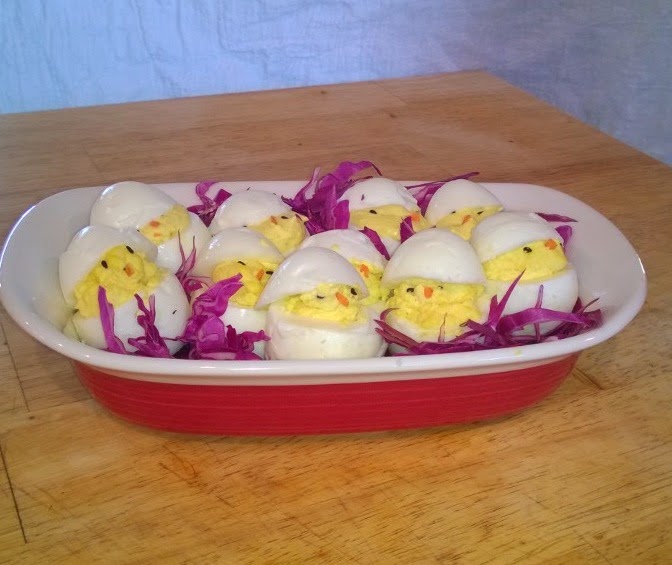
Now yesterday was Easter, and the weather was lovely. We had the family together for a few hours and I served deviled eggs, fruit salad and a lovely bread pudding using croissants and buttermilk.

The trick is to make the filling creamy enough to be tasty, but dry enough to hold its shape. I am working on it. :)
While everyone was eating, I tackled the old compost pile that I started 17 years ago as well as creating a raised bed for the asparagus I have coming in today. Sadly, I can't find a picture of it for a "before", but this is what I have the clearing down to:

17 years of composting leaves, scraps and rabbit poo, all finally getting used.
Where did I put all that compost? Why in a new garden bed of course!
Half done!
I am using building materials that had been left with the house.


When we moved in there were a lot of building materials laying around. The bricks were used as a walkway in the main garden bed and the concrete blocks surrounded the daylilies. I will be planting marigolds and such in the concrete blocks because asparagus doesn't play nice with other plants, but marigolds are helpful partners in the garden attracting pests away from the other plants as well as attracting pollinators for all.

I won't lie, it is hard doing all this will a busted up back and the other health issues, but even with the ouchies, I feel much more centered when I am out in the fresh air helping nature along. 

And, one more note on Spring gardening, my raspberries are growing beautifully!